
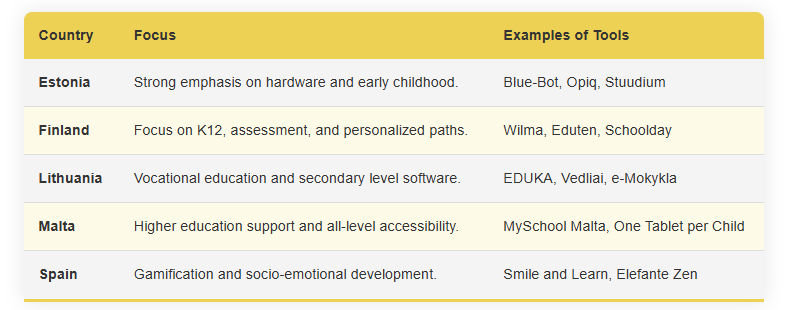
The rapid integration of technology in education has brought both unprecedented opportunities and unique challenges to the well-being of students and educators. As part of the WINDEE project, a comprehensive analysis was conducted on 103 digital educational tools across five countries: Estonia, Finland, Lithuania, Malta, and Spain. This study evaluates how tool features influence digital well-being and seeks to identify strategies to mitigate technostress in technology-rich learning environments.
The analysed tools span the entire educational spectrum, from early childhood to lifelong learning. The analysis prioritised the pedagogical value and accessibility of each tool, ensuring a thorough and educationally grounded evaluation. While most of the analysed tools are software-based (e.g. Moodle or Genially), the inclusion of hardware such as Blue-Bot and Lego Education SPIKE highlights the importance of tangible, robotics-based learning in developing early digital literacy.
Pedagogical approaches and student well-being
A key finding of the analysis is the shift toward pedagogical models that prioritise the learner’s psychological needs. Most tools are grounded in constructivism and cognitive learning, with a significant emphasis on personalised learning.
- Personalisation as a stress reducer: tools such as Eduten and Opiq utilise personalised learning paths.
- Socio-emotional learning (SEL): the analysis identified several tools that directly support SEL frameworks like CASEL and PERMA.
- Holistic development: platforms like Triumf Health and Schoolday focus on mood tracking.
- Mindfulness integration: Spanish and Finnish tools include dedicated mindfulness resources.
Mitigating technostress through design
Technostress often arises from technical complexity or a lack of support. The WINDEE analysis highlights that context-specific factors – such as having a built-in tutoring system – are critical for a positive user experience.
- User support: many tools feature integrated support systems to assist users in real-time.
- Active vs. passive use: the study notes that active use generally leads to higher engagement.
- Digital literacy: a recurring theme is the necessity of self-regulation as a prerequisite for healthy technology use.
Conclusion
The analysis of these 103 tools underscores that technology is most effective when it is pedagogically sound, ethically governed, and designed with the user’s well-being at the centre.